
1st Position Blues Harp – An Introduction (Part 1)
 A guide to straight blues harping
No force, however great, can stretch a cord, however fine, into a horizontal line which is accurately straight. Elementary Treatise On Mechanics (William Whewell)
The classic blues harmonica journey starts with a crusade to the Holy Shrine of cross harp. Whereupon, straight harp (normally in the guise of Oh Susannah) is swiftly abandoned. Drunk on the glories of success, and soon lavishly equipped with assault amplifiers and bullet microphones, the crusade continues.
New techniques are won – including tongue blocking, vibrato, blow bends and third position blues – before a dark specter looms like a cloud on the horizon; the ghost of first position past. It’s been neglected for too long and now it’s broken our serenity, and it’s raining torment. Here’s how to make amends…

 Playing it straight
Welcome to the first of our four part series exploring the magic of 1st Position blues harp.
Every contemporary blues harp player should really be proficient in at least 1st, 2nd, and 3rd position. There are plenty of other positions worthy of exploration and overbending has come of age, but these three positions provide the foundation of most classic harmonica blues.
The blues journeyman should also learn to identify each of these styles by ear and use positional playing sympathetically. Honking away in an alternative position for the sake of it might be impressive for a spell, but it may also demonstrate more about musical immaturity than harp technique. Unbidden, call it blues graffiti if you will. As artists our responsibility is to share the musical canvass, not to deface it. This means respect for fellow musicians, the audience, and the mood, but most of all for the song.
Why do we leave first position harping till later?
Probably because the first sound to catch our ear is cross harp (2nd Position). The bulk of harp music is played in cross harp and naturally we want to imitate what we hear. So 2nd Position is a very convenient portal for entering the blues arena.
Secondly, playing in 1st Position demands strong use of deep draw bends at the low end of the harp. This takes muscle and not everybody can cut it. Proficient use of high end blow bends is also essential. But it is hard to master. We may feel it is unachievable and shy away.
Finally, the options for expression in the middle register are extremely limited – unless you can overbend. So for most of us the middle octave remains barren. With blues licks each side and nothing in between, you will understand why we call it the Grand Canyon of harping. Newcomers are ill-equipped to traverse the gap.
 Considering our position
So let’s get the first things straight. Taking a C major harp and applying this to a standard twelve bar blues in 1st Position, the I chord will of course be C. The IV chord will be F (count four up C-D-E-F) and the V chord will be G (count five up C-D-E-F-G). Since familiar 2nd Position cross harp licks in G fit perfectly over the V chord, this might fool novices into believing they are hearing a cross harp number. As an example, we often hear a familiar ascent 2D..3D’..4B into a break-out 4D~5D trill over the V chord. Alternatively, the listener may be blissfully unaware that alternative positions exist, or even matter. Either way, as players the V chord means we can, albeit fleetingly, indulge our hard-won comfort zone with licks in Second Position cross harp.
Nonetheless, we’re barely scraping the surface here. Until now we’ve been gentle on ourselves regarding First Position duties. At worst we’ve been musically derelict. So in penance to the specter of 1st Position past, let’s plunge in headlong and really test our powers of concentration regarding the IV chord.
We’ve already established that the IV chord is F major. Conveniently, this marries up with what’s known as 12th position, which those in the know also call Lydian Mode. One way or another this will fit over our IV chord. The problem is it doesn’t sound all that bluesy in its natural state. Nominally speaking, the root note of 12th position is in 5D, which affords us space to range up and down the harp. From 5D we can map out a convenient major pentatonic scale 5D 6B 6D 7B 8D 9D 8D 7B 6D 6B 5D up and down. If we’re feeling really adventurous, we could also go from 2D” of course; 2D” 2D 3D” 4B 4D 5D 4D 4B 3D” 2D 2D”. All good, but where’s the blues at?
Foxtrot blues
 When constructing the major F blues scale, to play over the IV chord on a C harp in First Position (well done you’re learning the vocabulary) we’d start with 5D and move to our second note 6D’; that’s the all-important flattened third (Ab). This is perfectly achievable, even it feels a little awkward at first. The remainder of the scale will follow as Bb B C Eb F, but to play the next note of the scale, Bb, it’s crunch time. Without overblowing 6B#, we won’t find the Bb we need.
At which point, we can choose to grow and learn our first overblow, or we can simply walk away. But if we are prepared to pick up the gauntlet, the 6D’ we’ve already played will provide the perfect springboard; conventional overblow tutorials tell us so. The reed and our embouchure are both where we want them – we just use reverse thrust. And yes, to an extent, a successful overblow will depend on how the reed itself is gapped (ideally lower than standard), however 6B# is perfectly achievable on most standard tuned harps straight out of the box.
Top, middle or bottom?
So what’s it to be? You can persevere now and perfect this new overblow technique, or else you can turn and run to your safe place, never to return. Cue the sound of running feet. Hold on, just before you go, here’s a compromise, temporary or otherwise. Remember that F has three root notes on a C harp. There’s also one in 9D, surrounded by some useful components from the top-end C blues scale 7B and 10B. Armed with a few regular blow bends, we can carve out a whole new safe place if we want to.
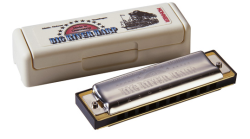 Which is partly why 1st position players jump to the upper register and, with the other F root in 2D”, drop back to the lower register with it’s signature First Position licks. (Did someone just say blow bends? If these are new to you too, follow the link further down this post or visit our key skills menu). What’s also true is that 1st Position blues players rarely visit the middle register, because the C blues scale here demands the following notes C Eb F F# G Bb C, which translate as 4B 4B# 5D 5B# 6B 6B# 7B . That’s a heap of overblow and ample reason to admit defeat.
First position basics. All you need to know on a postage stamp
Here are the essentials of first position blues harp:
• It has certain signature licks which make it instantly identifiable
• It usually has a melancholy feel
• It is found in deep low end draw bends
• It is found in high end blow bends
• It often switches between low and high end licks
• It offers very little in the middle register – unless you can overblow
• 2nd position cross harp licks work perfectly over the V chord in first position
• 12th position cross harp licks can work over the IV chord
What’s the Mode?
In musical theory, we call 1st position the Ionian mode. The Ionian scale is the one we are brought up on in the west. Anyone who has seen The Sound Of Music will know the song Doe A Deer. This is what we are talking about. Do-Re-Mi-Fa-So-La-Ti-Do. The important information lies in the interval, or distance, between each note. An interval can be counted in whole or half steps. We call these tones and semi-tones.
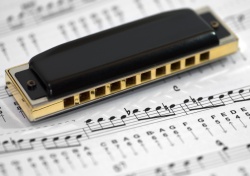 For the simplest example of the Ionian mode on a piano we would start on a C key and move up one white note at a time until we complete an Octave and arrive at the next C. The sequence of intervals we have covered is: Tone-Tone-Semi-tone-Tone-Tone-Tone-Semi-tone. In short hand this would be T-T-s-T-T-T-s, and this provides the layout, or DNA, of the Ionian scale in any key.
A step of one tone (T) comprises two semi-tones. We can see this clearly on the piano keyboard. The journey from C to D starts on C, passes over C# (also called Db) and finishes on D. A step of one semi-tone does what it says. So between E and D, or B and C, there is no black key. You can only move a half step. Which, coincidentally is also why we don’t find a regular draw bend in holes 5 and 7 on our C harmonica.
The blues scale
The blues scale is the foundation of blues harping no matter which position you decide to play in. All principle blues positions use notes from the blues scale so it’s important to develop some fluency in this pattern. It helps to locate the sweet notes you need, avoid the sour ones, and express yourself confidently in the blues idiom.
 For 1stt Position blues, we have to start with the C blues scale using 1B 4B 7B or 10B as our root notes. Start by playing the equivalent Second Position cross harp blues scale on an F harp (2D 3D’ 4B 4D’ 4D 5D 6B) Now try to match these notes on a C harp between holes 1B and 4B. It should be easy enough, although you will notice that you can’t flatten the second note of the scale on the C harp (without an overblow in hole 1). For comparison, try the same experiment using Second Position on a D harp, and 1st Position on an A harp.
Blow bending for beginners
Please note that for our third instalment, and to complete First Position blues learning, you’ll need blow bends. If you have yet to find these, roll your sleeves up and visit our Harp Skills page. In the meantime let’s hear that clip by Nine Below Zero again. The song is called Doghouse and you’ll find it on their Don’t Point Your Finger album. It’s played in first position using a B harp and, for information, the opening top-end lick is 10B 10B’ 9B 9B’ 8B 7B .
In parts 2, 3 and 4 we explore…
• Low end blues scale
• Low end signature riffs
• High end blues scale
• High end signature riffs
• Bridging the middle octave
• Some handy little extras
Musical examples will be drawn from Paul Lamb & The Kingsnakes, Sonny Boy Williamson II (by way of Kim Wilson), Jimmy Reed, Charlie Musselwhite, Winslow Yerxa and Jerry Portnoy.
Links to associated posts:
First Position Blues Harp – An Introduction (Part 2)
First Position Blues Harp – An Introduction (Part 3)
First Position Blues Harp – An Introduction (Part 4)
“And the last shall be first…….”. A position I have yet to explore (bar Camptown Races and Good King Wenceslas) I must investigate further. Those old 20s players like Jazz Gillum were very fond of it – infact I believe Jazz was primarily a first position player?
I always think of 1st position when playing in cross harp because we usually play 1st position licks over the IV chord so for a player to say he or she doesn’t play in first position isn’t entirely true. They just need to expand their IV chord licks and slip in cross licks on the V like you said.
Thanks for a great article
Tony
this is the best explanation about 1st position I ever seen, thanks…I was trying to play “Murder in the first degree”by Rod Piazza, it is a great example of everything you mention in this article
Mo my friend, you are very kind. I’m trying to tell it like it is and cut out all the fancy, technical stuff. Dave Barrett has a book on 1st Position Blues which is well worth a look. And as for Mr Piazza, what can I say. A true technician and a lovely guy. I had the pleasure of seeing him standing on the tables in Vegas while he played. A real showman! Now try Hard Hearted Woman by Big Walter ;O)
Once again you have entertained and enlightened… there’s a lifetime of knowledge in part 1- can’t wait for part 2!
Glad you’re enjoying the journey Andy. stick with it!