

Why Are My Harp Notes Set Out This Way?
‘I do desire we may be better strangers.’ As You Like It (William Shakespeare).
Background
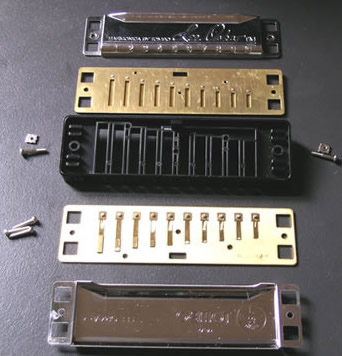 One of the first exercises we learn at the Harp Surgery is playing the major scale from blow 4 up to blow 7 (the mid octave). We use this to develop single note playing and movement around the harp. Simple as it may seem, it’s a great way of learning to navigate the new instrument and to develop an aural awareness of the changes that take place (as we cannot actually see them under our nose). We also use it to warm up at the start of subsequent sessions.
Once the central doh-ray-me is mastered, we then learn to extend upwards from hole 7 to hole 10 (the upper octave) and consider the 10 hole blow bends necessary to complete the sequence. Lastly we apply the process to holes 1 to 4 (the lower octave) and consider the draw bends necessary to complete the pattern. Once we can play the major scale in each octave fluently, including bends, we have the ability to range the length of the harp in 1st position, using it as one homogeneous instrument.
So why is hole 7 back to front?
Coming back to the central scale in holes 4 to 7, there is one thing that sticks out like a sore thumb. Hole 7 is backwards and trips us up every time. For those who are totally new, the mid scale on any 10 hole diatonic runs Read more
Louis Borenius 1949-2009
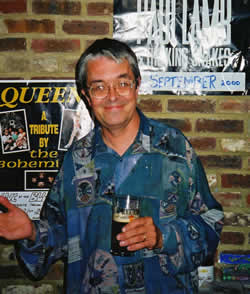 It is with great sadness that I have to relate the passing of Louis Borenius; husband, father, friend, and musician. Louis died of heart failure in Salisbury Hospital early last week. The news has come as a deep shock to all who knew him.
Some of you will have enjoyed performances by The Blackjacks over the years. Whether it was at the UK national blues festival, other nationwide venues, Ain’t Nothin’ But in London’s Soho, or locally here in Brighton & Hove, Louis was an integral and vital figure. And not just with the Blackjacks. He also drummed or played vibraphone for Coup d’Etat, Big Chief, Bop Brothers and countless other top jazz, blues and rock ensembles. Indeed Louis’ pedigree extends right back to the early jazz days of Ronnie Scotts and the UK’s emerging live music scene. You mention them, he’s played with them.
Today’s service was a beautiful testament to one of life’s rarest gentlemen, intellectuals, humanitarians and gifted music makers. Over 200 assembled to pay their respects. And those who couldn’t join the funeral sent their condolences or turned out for the evening’s wake at Brighton’s Komedia. As one friend put it so perfectly, Louis knew so many high profile musicians, yet he always remained wonderfully grounded. Read more
Overcoming Beginner’s Twitch
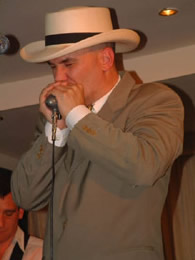 What is beginner’s twitch?
It happens when you first start learning the harmonica. You hit a bum note, so you extend your arms from the elbows to visually locate the right hole on the harmonica, while shaking your head and tutting. By the time you bring the harp back under your nose, the hole’s gone out of focus, you miss your note again, so you tut and extend your arms… That’s beginner’s twitch!
Why do I do it?
Because you’re not keen on playing ‘blind’. That’s perfectly understandable. On every other instrument, you can see what your fingers are doing. On the harmonica your mouth is providing the wind and locating the notes simultaneously. It’s doing what your fingers would otherwise do. That’s just not normal!
What’s the solution?
You haven’t yet developed the navigational systems to locate the right hole without actually seeing it. Think laterally. Ask yourself how you would play the harmonica in the dark? Read more
Charlie Musselwhite (Part II) – Komedia, Brighton, 18th November 2008
“Why we elected Bush worries my mind“
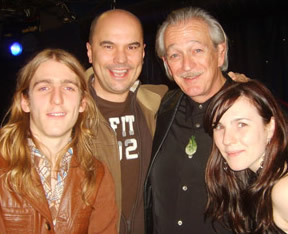 I must confess, having seen Charlie in action again after a break of seventeen years, I remain unconvinced about his credentials as a performing artist. Last time he was upstaged by his backing band. This time his lengthy digression into solo guitar and rack harp was brave, but wasted. Any impact was lost owing to the wagon load of down home guitar already delivered by Dave Peabody. The audience had thirsted far too long for that big town electric harp. When it came, of course it was well received, but it was still insufficient to quench their frustration. Barely a twenty minute stretch at the end of a long evening. When Deep Purple did that, fans tore down the stadium, uprooted street furniture and rolled cop cars. Tonight people had the last bus home to think about.
I had hoped that my enduring ambivalence towards Charlie’s music would melt in a blinding epiphany this evening. Having seen the show however, there was no change. Instead, I felt my reservations had been vindicated. One nagging question still simmered though – what exactly was it I was blind to that others understood so clearly? It mystified me. The imaginary urchin continued crying out from the crowd – ‘the Emperor’s wearing no clothes.’ Read more
Perfecting that deep 2 draw bend – Low Rider (War)
All my friends know the low rider
Few students ever arrive at the Harp Surgery knowing exactly how many bends there are or where they’re all located. Some think they do, but on closer inspection find there are gaps in their knowledge or ability. Some can draw bend but not blow bend. Some are unable to bend at all. This is a skill area that almost always needs attention. I firmly believe players of any ability should spend time working on the accuracy of their direct bends. No matter how good you are, those 3 hole draw bends can never be taken for granted.
When you start bending, it always pays to remember the Harp Surgery’s golden rule – it’s ok to make mistakes. That’s why they put erasers on the end of pencils. Perfecting your bends will involve an amount of trial and error. You will learn from your mistakes. And remember this is one of the most significant points of any harp player’s development. Be patient and persevere. You’re breaking into the big time!
The low rider is a little higher
In another article, we spoke about monitoring the accuracy of bends – How do I know I’m bending in tune? My conclusion was that all the electronic paraphernalia in the world is no substitute for using your own ears. Furthermore, instead of learning each individual bend in isolation with an electronic tuning device to determine your accuracy, what better than to pick a fun tune and learn to play the bends in context. You’re a musician after all; if the bend ain’t right, the tune won’t work. Read more