Joe Filisko – The Brunswick, Brighton & Hove, Fri 31st July 2009
My bags are packed, I’m ready to go

I am delighted to report that Joe arrived safely into the UK in advance of his residency at the University of Northampton Blues Week. He was hosted in Brighton & Hove by Stuart McKay of the UK’s National Harmonica League (NHL) and Roger Trowbridge, the NHL Chairman.

Hove actually

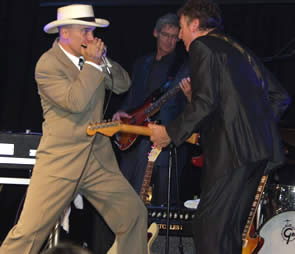
Stuart engineered a fabulous harmonica-centric evening in Brighton (well… Hove actually… near France), where Joe was welcomed by a groundswell of enthusiasts from near and very far. NHL Chairman Roger was in excellent form. As was Con O’Neill from the NHL’s London Harmonica Group – Con rode all the way to Hove from the M25 by bike and was looking amazingly fit as a result. It was also great to see Ben Hewlett from the NHL’s Bristol community – equally well done for driving all this way Ben. And blues hats off to another supporter who had driven down from Oxford. Read more
Messin’ With The Kid

What’s this I hear going all around town?

It was a great honour for the Harp Surgery to receive an email from Junior Wells’ daughter yesterday, confirming the legend that the great Junior Wells was indeed buried alongside a tray of Lee Oskar harmonicas. In a recent interview with Lee Oskar, the maestro couldn’t recall the full facts from that sad day, however it is now clear the friendship he had with Junior was a very special one. Then most unexpectedly the Harp Surgery received the following astonishing e-mail..

This is to verify that Jr Wells was buried with Lee Oskar harmonicas. I know this to be a fact because I was there at the funeral. Mr Oskar also played the most beautiful song (solo). I have never heard a harp played that way before. I would like to thank him for being his friend and honoring us with his presence. The reason I know all of this is because Jr was my dad. I miss him everyday but his fans and friends help keep him alive for our family. May God bless and keep all of you. Thanks Jr’s Family

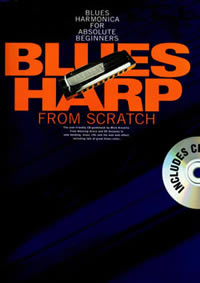
Blues Harp From Scratch (ISBN 0-7119-4706-6)

Can you recommend a good book for learning blues harp?

I am often asked this question and the answer is yes. One I often prescribe is Blues Harp from Scratch by Mick Kinsella, published by Wise Publications. I remember its first incarnation, Play Blues Harp In 60 Minutes, which I picked up at a Johnny Mars master class in Brighton a few years ago. It was a pocket size manual and CD which, although brief and not error free, was actually very easy to get along with. It was well structured, concise and free from inaccuracy. Of course you could never really learn blues harp in one hour, that takes years rather than minutes, however this was a great little entry guide.

The revised and extended A4 version is great. As you would expect, it introduces you to the C major scale and breathing exercises straight away, before tackling Oh Susanna and Amazing Grace in first position. With the basics familiarised, Mr Kinsella moves into cross harp using the basic, bend-free, blues scale 2D 3D 4B 4D 5D 6B with more exercises. Two lovely blues tunes follow, Easy Street and Trouble Free Blues, both of which educate the newcomer in the art of chord changes and promote technique building such as glottal stops, short runs and repeated blues licks across holes 1 and 2. The tunes can be challenging at first, but they help to build important foundation skills. Read more

Making It In 4th Position – When Johnny Comes Marching Home […with tab]

And let each one perform some part, To fill with joy the warrior’s heart.. Louis Lambert

Applying the circle of 5ths to a C Major diatonic harmonica enables us to determine the alternative keys and their associated positions that are available on the same harp. As a reminder:

1st position (straight harp) is in C major. Your root note is generally blow 4.

2nd position (cross harp) is in G major. Your root note is generally draw 2.

3rd position (slant harp) is in D minor. Your root note is generally draw 4.

4th position is in A minor. Your root note is generally draw 6.

The first three are the most widely used positions on the harmonica. In each case it is helpful if we can find a well known melody that best demonstrates that position and will map out the principle safe notes for us. In first position the choice is limitless. The most often used melodies are Camptown Races, Oh Susannah, When The Saints Come Marching In and Amazing Grace. In second position the choice is also very wide, especially when we start to use bent notes. In third position the melody to Scarborough Fair is the best example I have come across. You can also try What Shall We Do With A Drunken Sailor or even the theme to the Hawaii 5-O TV series. For mapping out fourth position, try When Johnny Comes Marching Home.

Read more

Jiving With The Greats: Lee Oskar – 22nd July 2009

Towards the end of last year, a student came for his first lesson at the Harp Surgery. ‘So can you already play anything?’ I enquired. ‘A few bits and pieces,’ came the reply, ‘I like the Low Rider tune.’ I nodded politely but had to confess I didn’t know it. So he played it for me. Dah-dah dah-dah dah dah dah, dah dah-dah dah dah! We spoke about the Marmite advert that used the riff and then carried on with the lesson.

I asked the Riverboat Captain (our webmaster) what he knew of Lee Oskar, WAR and the Low Rider tune. ‘You should check it out,’ said the Captain, ‘it’s good stuff. Especially the ‘World Is A Ghetto‘ album.’ And he filled me in on an area of music about which I had been totally ignorant. I looked at my small collection of Lee Oskar harmonicas in a totally different light. Time for the Good Doctor to pull out his press card and investigate. It was early morning somewhere near Seattle…

So Lee, tell me about arriving in America, aged 18, straight from Denmark, with no money..

Yes, I left Denmark when I was 18 for a life in the USA. I wanted to be in the music business. It was my main interest. My heart was in it. It was my dream.

Were things different in Europe at the time?

Yes, very different. The whole industry was focussed on the US rather than Europe. The UK had the Stones and the Beatles, but the US was the main hub for music. Europe has changed now. The music industry is now more homogenised all over the world. Read more

Beefing Up Those Bends – 4 Draw Bend

Here’s a simple two-part exercise to help strengthen your 4 draw bend. We’ll assume you have already found your draw bend, but haven’t perfected playing it in isolation without scooping down from the clean draw. If you have already perfected them, you may still find this exercise useful in sustaining your bending muscles and add it to you ‘harp gym’ regime. Hitting a bend accurately and without scooping is known as direct bending – a skill which is central to controlled playing. If you haven’t yet attempted any bends, why not take a look at the draw bend page from my Harp Skills menu here.

Stage One

We start by moving from the draw note down to the draw bend as slowly as possible. The objectives are to maintain a good tone (no loose air), a respectable amount of volume and to control the descent. Now do this again, but saving enough lung capacity to hold the bend as long as possible. Remember to descend as slowly as possible first. Read more

Sign up for news and exclusive offers