learn harmonica

Amazing Grate – First Steps On Those High End Holes

How strange the sound

Young Malcolm called into the Harp Surgery today, hot on the heels of our Harpin’ By The Sea event. Having witnessed Will Greener’s performance of Amazing Grace, he was keen to revisit the tune from scratch.

Using a C major 10 hole diatonic, we knew that the tune can be played using 7B as the root. But while this avoids any nasty bends, it does sound rather shrill. Also, as a beginner, it demands a strong embouchure and some dexterity around a specific triplet of notes. Read more

Harping in Havana – a bluesman’s introduction to Latin diatonic

Latin American diatonic for the uninitiated

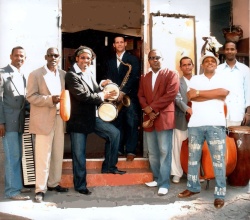
To witness Cuba’s musical pulse first hand and sip Mojitos in the sweat of Havana’s Bar Montserrate is privilege enough, but to sit in with the house band Sabor de Cuba, play the diatonic harmonica and get out alive? Ay Caramba! That’s the stuff of dreams.

The Montserrate is a tourist magnet for genuinely good reason. Kitsch-free, under a blanket of humidity and aromatic cigar smoke, the throb of its acoustic Latin music is quite simply mesmerising. Add a splash of Ron Cubano, a serpentine twist of Salsa dancing and you have all the ingredients of an impromptu Latin fiesta. Next time you’re in town, drop in and join the party.

During a break in the music, house vocalist Luis Franklin presented the band’s bongo drums to guests sitting at the bar. Stepping up, the Good Doctor patted a rhythm across the skins which drew a nod of approval from Luis. Followed by an offer of sale. Sadly a shortfall in funds and luggage space forestalled business and in broken Spanish the Doc explained he too was a poor musician. What do you play? Luis asked. The Doc produced a lone Lee Oskar diatonic from his bag.

Read more

1st Position Blues Harp – An Introduction (Part 2)

A guide to straight blues harping

In Part 1 we looked at an overview of first position. We considered why it may be something blues players put off till later. We noted that 1st position blues mainly comprises deep low end draw bends and confident high end blow bends, and that the middle octave has little to offer to those who cannot overbend.

We also recommended that blues players develop the ability to identify positional playing by ear. This isn’t as hard as you might believe. It’s like birdsong. You could probably recognise the call of an owl, a seagull or a finch right? Well the three principal blues harp positions also have their own signatures.

In this, the second part of our series, we look at the bottom end blues scale in 1st position and its trade licks. Meantime here’s more of our series theme tune from Nine Below Zero. The song is called Doghouse and it’s from their second album, Don’t Point Your Finger. It’s played in first position using a B harp and, for information, the opening top-end lick is 10B  10B’ 9B  9B’  8B  7B .

Read more

Love Me Do – The Beatles [..with tab]

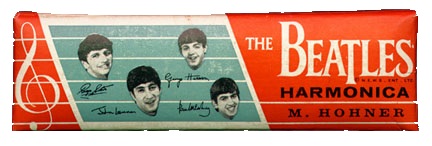
Beatles HarmonicaI’ll always be true, so please, love me do

Much has been written about John Lennon’s harmonica playing with The Beatles. He started playing at a time in the 1960’s when American blues music was taking the UK by storm. Little Walter, Muddy Waters, Sonny Boy Williamson and Howlin Wolf all toured the UK. The Rolling Stones were stiff competition in the popularity stakes, with harmonica work by the multi-talented Brian Jones and many other UK R&B bands followed.

Bruce Channel was also touring the UK on the back of his ‘Hey Baby’ hit (many will be more familiar with the 1990’s cover version, famous for its loutish Ooh-Aah chant). With him was Delbert McClinton, the harmonica player on the hit. Legend has it that Delbert McClinton taught John Lennon cross harp while Channel’s band was touring Merseyside. In a later interview however McClinton busts this myth.

Read more

Harmonica Effects 1 – Police Sirens

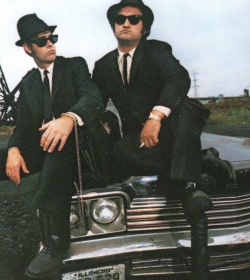
Jake, Elwood and The Blues MobileOur Lady of blessed acceleration don’t fail me now

As we know, every Blues Harp player grows twitchy when they hear the sound of Cop Cars in pursuit. Unless, of course, they happen to be driving one themselves. But have you ever tried to imitate the sound of a police chase on the harmonica? Grab your nearest diatonic and we’ll take a look. But before we do, just a few words from our sponsors, fresh from the Mount Prospect City police auction..

  • Jake: The Caddy. Where’s the Caddy?
  • Elwood: It’s been traded for a microphone.
  • Jake: I can see that.
  • Elwood: Like it?
  • Jake: No I don’t like it
  • [Elwood floors the gas pedal and leaps an opening drawbridge]
  • Jake: Car’s got a lot of pickup
  • Elwood: It’s got a cop motor, a 440 cubic inch plant, it’s got cop tyres, cop suspension, cop shocks. It’s a model made before catalytic converters so it’ll run good on regular gas. What do you say, is it the new Bluesmobile or what?
  • a brief pause as Jake lights his cigarette with a Zippo lighter – having previously thrown the electric car lighter out of the window]
  • Jake: Fix the cigarette lighter Read more

Beefing Up Those Bends – 3 Draw Bends

‘Be lion-mettled, proud, and take no care who chafes, who frets, or where conspirers are’ Macbeth (Shakespeare)
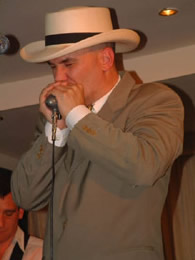
Blow Your Harmonica, Son!Brace yourself and take a deep breath. It’s time to face everyone’s worst harmonica nightmare – the three witches. They’re the three hole draws to you and me. As you are no doubt aware, if we exclude the overdraws in hole 10, this is the hole that carries the most bends. And they’re the ones we secretly dread. They never sound as strong as other notes or bends across the harp (even in the hands of the masters) and they never quite do what you want them to. I’ve heard many players camouflaging the reed’s inherent imprecision with vibrato or else they just don’t go there. Like the inconvenient pattern swap across holes 6 and 7, subconsciously we wonder who designed such a frustrating tuning system in the first place.

The message from the Good Doctor is deal with it. Embrace the challenge and don’t shy away. OK, our ears can detect the tonal imperfections, but so what? No cracked eggs, no omelette. It may be the weak spot on the harp, but it’s also part of it’s character and charm. Make it yours. So let’s feel the fear and do it anyway. Follow me.. Read more


Sign up for news and exclusive offers