Beefing Up Those Bends – 4 Draw Bend

Here’s a simple two-part exercise to help strengthen your 4 draw bend. We’ll assume you have already found your draw bend, but haven’t perfected playing it in isolation without scooping down from the clean draw. If you have already perfected them, you may still find this exercise useful in sustaining your bending muscles and add it to you ‘harp gym’ regime. Hitting a bend accurately and without scooping is known as direct bending – a skill which is central to controlled playing. If you haven’t yet attempted any bends, why not take a look at the draw bend page from my Harp Skills menu here.

Stage One

We start by moving from the draw note down to the draw bend as slowly as possible. The objectives are to maintain a good tone (no loose air), a respectable amount of volume and to control the descent. Now do this again, but saving enough lung capacity to hold the bend as long as possible. Remember to descend as slowly as possible first. Read more
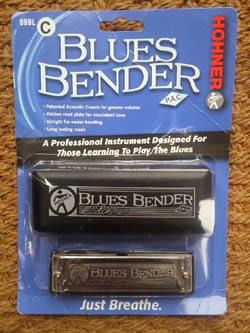
Hohner Blues Bender

Bright light city gonna set my soul

If you are ever in Las Vegas and have time on your hands, I strongly recommend you make your way to the Guitar Center at Town Square. This would-be European Altstadt has plenty of shops and restaurants where loved ones can relax while you lose yourself in an underworld of instruments and sound equipment. You will find everything from percussion, guitars and keyboards to amplifiers, DJ decks and PA systems. Walking into the Guitar Center is the musical equivalent of a trip to Willy Wonka’s.

Read more

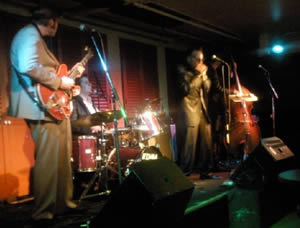
Rick Estrin & The Nightcats – Biscuits & Blues, San Francisco, 29.Mar 2009

Get in the soup and slide

This was one of the most entertaining nights I have ever experienced at Biscuits & Blues. In fact anywhere. The Nightcats took the stage with the sole aim of knocking the audience clean off their feet. And that’s exactly what they did. I defy anyone to sample this band live and walk away not feeling utterly satisfied.
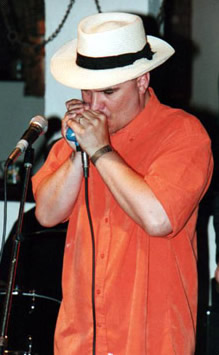

It was a joy to see Rick Estrin in full flight and appreciate first hand why he has made such a name for himself not only as a harmonica ace, but also as an engaging raconteur and convincing song writer. Jerry Portnoy rightly describes him as a modern day Lieber & Stoller.

Sadly I never got to see the original line up with Little Charlie Baty on strings, although I am certainly aware of his strong reputation as a performer and studio artist. “All that meat, and them potatoes too!”Indeed his recordings with the Nightcats are quite sensational. Charlie is still around, but he’s taking five. Something they call ‘soft retirement’ in the trade. We can expect to see him again for band reunion gigs and special festivals, but in the meantime his slot is anchored by guitarist elect, Kid Andersen, whose playing is simply astonishing. Read more

What Does ‘Cupped Harp’ Mean?

‘Work your hands from day to day, The winds will blow the profit.’ Louis MacNiece

Introduction

It all boils down to what you do with your hands. When playing acoustically, there are two principal hand positions – open and closed. Harp players also call the closed position ‘cupped’. The term ‘cupped’ probably derives from the way we would naturally use our hands to scoop and hold drinking water.

When playing amplified harmonica there are three further scenarios that need consideration; the way we use our hands changes in each case. The first scenario is playing semi-acoustically through a vocal microphone (mic). The second is playing with an open hand position through a hand held mic. The third is playing with cupped hands through a hand held mic. (The hand held mic can be either the vocal mic or a separate harp mic). Let’s look at all the options in greater depth. Read more

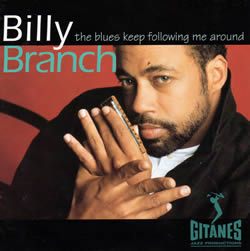
Billy Branch – Kingston Mines, Chicago, Sat 21.Mar 2009

The blues keep following me around

Ever since buying a copy of the 1990 W.C.Handy award winning album Harp Attack, Billy Branch has had me intrigued. He’s pictured on the cover as the new kid on the block, alongside three legends – Junior Wells, James Cotton and Carey Bell. Billy provides fresh reinforcement for the old guard, enlisted to extend the Chicago Harp tradition rather than bend it (as Sugar Blue might have done). The album is of course a valuable celebration of ChiTown honking, however the full extent of Branch’s artistic ability was probably hidden under the barrage.

So it was when I heard his 1995 solo album, The Blues Keep Following Me Around, that I really began to appreciate Billy’s work. Again it stems directly from the Chicago idiom – how could it not – but it makes a fearless march forward. It is new, energetic and wonderfully varied. Billy’s passion for the blues shines through the whole recording and he takes no prisoners. His cover of Tony Joe White’s Polk Salad Annie is a particular classic. With a heap of soul in the vocals and a brooding, pulsating groove, Mr. Branch takes you down in Louisiana and dumps you right on your…corn patch. Which reminds me – Billy is not only a cool harp player, he is also a magnificent singer. Read more

Jiving With The Greats: Jerry Portnoy – Boston, 2.April 2009

…he, whose heart was that of a little child, had answered to his name, and stood in the presence of The Master. William Makepeace Thackeray

Prologue

For anybody looking to master the art of Chicago and blues harmonica, look no further than Jerry Portnoy’s front porch. Study his Grammy Award winning work with the Muddy Waters Band. Update this by investing in his solo project Home Run Hitter. Then check out Down In The Mood Room – it’s predominantly, though not exclusively, jazz. Give it time if you’re a bloozer. You’ll soon understand what Jerry has to say. Then get yourself a copy of his instructional package – Blues Harmonica Masterclass. It’s not cheap, but you get every ounce of bang for your buck, plus it’s the real deal straight from one of Muddy Waters‘ monolithic harp dynasty.

Harp Surgery visitors and students will know that Jerry Portnoy‘s work is regularly mentioned on this website. It also features in our teaching sessions. Most recently we’ve been mastering his version of Misty from the 1995 Home Run Hitter album. One student in particluar, Rob Ryman, has also been working on Real Gone Guy (from the same record). These are just two of countless numbers that carry Mr Portnoy’s hallmarks of style, accuracy, tone and expression. Read more

Sign up for news and exclusive offers